header image by frl.zucker

Wednesday, 4 August 2010

UK Feminista Summer School


I ecstatically posted about this as soon as I found out: UK Feminista, despite only existing since March 2010 and operating wholly through the work of volunteers, organized 'two days of feminist training, explaining and gaining', a FREE event on feminist activism in London. Held at Amnesty UK, it was overbooked and a visible 99% of the 350 registered attendees came. Nadine and I were moving house that weekend, which made it a bit difficult, but I skived off for some time and went as Women Fire's delegate.

Maybe the most amazing feature of the event was that it provided genuinely fun and interesting talks for activism beginners and veterans alike. Despite many cautionary remarks that 'we're preaching to the converted', it was far from redundant to hear statistics, learn skills, and absorb enthusiasm from various speakers. Just from listening I felt so inspired I started taking notes for future endeavours/involvements/articles and frankly, nothing beats that intense feeling of wanting to do something RIGHT NOW, and being given some actual tools as opposed to just walking up and down the room reeling from frustration. It's also refreshing to be able to talk to people who despite very different backgrounds and occupations share your views, and you don't have to defend yourself before you even finish making a point. Also very important is the realization that your power lies in numbers, and there are those other people out there - so if you organize, you can actually achieve something, and you really should try.


UK Feminista was started by Kat Banyard, author of The Equality Illusion: The Truth About Men and Women Today, who gave a particularly inspiring speech during the first panel The Importance of Feminist Organising: that more and more grassroots feminist movements are emerging, despite the general society's claims that equality is achieved and there is nothing else to fight for. Banyard's book dispels those myths, displaying research of amazing scope proving that gender inequality is still a serious issue. She pointed out that after a 'ten year drought' we had 'six feminist books in the last 12 months', and that publishing trend was definitely reinforced by an upsurge in actual activism, from NGOs and local groups, in form of blogging as well as marches, campaigns, demonstrations. In a stark contrast, perhaps the most cited statistic of the weekend had been about women taking about 70% of the consequences of proposed budget cuts in the UK. On the same panel was Gwendolyn Sterk from UK Joint Committee on Women, who reported that of the four sister organisations from across the UK that made up the Committee (Engender, network of women’s organisations in Scotland, the National Alliance of Women’s Organisations (NAWO) in England, Women’s Voice in Wales and Northern Ireland Women’s European Platform) only three were still operational: Women's Voice in Wales was recently denied funding and its future is uncertain. Women's issues are widely seen as a fringe, as something marginal 'real politicians' don't have time for. Actually thinking about it, most people probably don't realize women's issues are everybody's issues. And allegedly there are more men called John in the Parliament than women - sounds like a joke, right?

© Kirsty McCall-Thornley

The enormous strength of the first day of summer school was its focus on practice. The afternoon was split into workshops on different levels of involvement: from how to run a feminist group to how to organize a Ladyfest, on running effective campaigns, organizing demonstrations, creative campaigning and direct action, using gender equality duty and other laws to promote your campaign ends, or what to look forward to in the feminist year ahead. If that wasn't amazing enough, all the materials fromt he workshops will be available at the UK Feminista website in the coming days. Simultaneously to the events, UK Feminista volunteers were tweeting, providing good quote selections and links, and doing it so well I didn't even feel the need to take many notes and instead have that online record of what was being said. I encourage everyone to go through the resources grouped under the #femschool hashtag on twitter (you can view it even if you don't have an account yourself), and to have a look at the materials when they're posted on UK Feminista - where in fact you'll find all kinds of useful info on local groups, campaigns, feminist links, and also discussion boards. A goldmine of news, information, and also people! What struck me about the event, aside from supreme organization, was the enthusiasm of everyone involved, organisers and participants alike, and the general friendliness - people were chatting away and forming new alliances all the time. After the event ended, UK Feminista volunteers announced they were going to dinner somewhere nearby, and everyone was welcome to join - in the end, about 20 of us went to a Vietnamese place on Kingsland Road to spend another 2-3 hours exchanging stories. I was about to go home after that, when on the way to the bus stop we passed a strip club, and someone said we should sticker it with the Sexist Shit and Feminisn't stickers we got earlier in the day. As a result, an ad hoc feminist action happened, and the next day the club's email address was still enhanced with a Sexist Shit note. All this was filmed - I hope to post the videos soon. That relatively small action made us feel so inspired for at least a couple of people who were going home to fall down on a couch instead found a nice pub to sit down in and keep talking to each other. There's no better feedback for an event than when people just don't want it to end.


© Kirsty McCall-Thornley

The second day was a lot more opinion- and discussion-based, but great training was still being given: from how to use the media to how to influence politicials (theyworkforyou.com to check who your MP is and what they're doing), how to fundraise, include disabled people in campaigning, promote diversity within feminist groups, and why is climate change a feminist issue (I'm especially looking forward to the materials from this to come up online as I missed it, attending using media instead). At lunchtime there was a stand up show from Lynne Parker of Funny Women (which I shamefully missed getting actual lunch - I hope there will be videos). Two arguably biggest events of the day, however, were the opening and closing panels with Big Names. Women in the Media was led by Jess McCabe of The F-Word and had Hannah Pool (ex-Guardian/freelance journalist) and Kira Cochrane (Guardian women's editor). All three talked about their experiences with the media (including a funny, but actually quite depressing story of how Hannah Pool set up a white male comments account as Harry Pond and didn't get any of the abuse she did get as herself). Only 18 of 100 people on media's most influential list are women, and out of 18 national papers one has a female editor, reported the panel, and the recounted experiences were more or less along the lines of challenge and hardship (but also some hope). Pool's story exposed sexism and misogyny on the Guardian's website (cause just because you read a lefty paper doesn't mean you can't be sexist..), but also instantly motivated people to get their opinions out there, whether working in the media or not, just by presence and comments. Granted, under the excellent post-summer school write-up from Bidisha there is already a sea of disgusting, disgusting comments. Just asking people whether they were feminists is a very revealing question, and an important one to ask. Someone from the audience tackled the enormously important but very unpublicized issue that most instances of ageism in the media are in fact straight cases of sexism. All panelists agreed that to be a female journalist takes more effort and more talent, but through their examples showed it was possible, and important. Exposure is crucial for a greater awareness and understanding of feminism, so every publication counts - in all types of media, not just ones targeted at liberal audiences. Also platforms brought forward by web 2.0, like commenting facilities on all media sites, as well as blogging, facebook, twitter - it all counts and helps to change people's minds.


© Kirsty McCall-Thornley
That first discussion was heated, but mostly in unison - the closing panel, Feminist Question Time with Bidisha, Dr Aisha Gill (Roehampton University), Sunder Katwala (Fabian Society), Karon Monaghan QC (UK Feminista) and Julie Bindel, provoked a lot more controversy. Julie Bindel said there was a lot of terrible anthropological research, particularly concerning women in the sex industry, and that they should not be treated as an anthropological field research group, but that there should be good quality social research instead. She went as far as saying that if she had one bullet in the gun, it would not go for the pimp, but for the academic who's all into the sex industry. Dr Aisha Gill was talking a lot about how the media essentialize women and in cases of trafficking for example, create stories of 'good victims'. Both raised a lot of comments and if it wasn't for time limits, this could have gone on forever. Interestingly, one of the questions on an earlier panel concerned dealing with disagreements within the feminist community. There isn't really an answer for that, just as there isn't one for tackling antifeminism, especially when it's displayed by women. There had been attempts to give advice on this (watch a video of this question on femblr), but all, in my opinion, failed: 'just being on the girls team' is a really not that simple, it's a slogan that doesn't help much when you face women who are misogynist themselves, nor does it when faced with super offensive comments (like those under Bidisha's article). Julie Bindel said 'we make a lot of excuses for men to the point where we praise them for not being fuckheads', which made everyone laugh, but about five minutes later someone angrily said from the audience that the men (there were a couple in attendance) must feel very excluded in the current talk, to which both Bindel and Bidisha reacted heatedly. As @inspirewithhope on twitter remarked, it was sad to see gender binaries reinforced in most of the conferences - people kept talking about *both* genders, *both* sexes, as opposed to all of them. The sex industry came up a number of times, but without a clear and visible designate - prostitution, trafficking, porn, strip clubs were all mentioned, but those issues are so broad, and the sex industry comprises of many more branches, each deserving an analysis. Not saying that sex industry doesn't hurt women and isn't a product of inequality, but these matters have traditionally been massively controversial within the feminist movement and that variation of opinion was not addressed at all (like the mixed stance on pornography, and the emergence of what could by some be called 'feminist porn', or pornography for women - see a previous post). However, overall I am inclined to say it was the best summer school I ever attended - really inspiring, a great opportunity to learn as well as meet people, and acquire skills and information to proceed with conviction and fury. 'We've had wave after wave of feminism; we need a tsunami of feminism. Mass civil disobedience is the only way they'll listen.' 'There's not a central office for activism, you have to do it yourself.' 'Feminism is about social justice and basic human rights... Of course we still need feminism, that shouldn't even be a question.'


© Kirsty McCall-Thornley


More feminist summer school coverage:
UK Feminista official summer school resources (including some of the presentations)
Kira Cochrane's article 'Feminism is not finished'
Bidisha's commentary Women's mass awakening
Radio 4's 'Exciting time' for British feminism with Kat Banyard and Gaby Hinsliff
Discussion post with summer school reflections, links to blog posts, etc
review on Daily Feminist Action
We Mixed Our Drinks review 
At Home blog
Notes on a Campaign by Delilah
femblr video with advice on countering antifeminism


More links:
Equality Now
Women's Aid
Womankind
Eaves
Fawcett Society
Southall Black Sisters
Women Against Violence
Justice for Women
European Women's Lobby: Centre on violence against women
Pink Stinks
Ladyfest
Strom In A Teacup 
The Girls Are
OBJECT
Lash campaign


NEXT CONFERENCE: Feminism in London 


I'm going. Register here!

Iriarte Iriarte online shop

Just to let you know, Carolina of Iriarte Iriarte who I last posted about just opened an online shop for her bags (and wallets). Check it out at iriarteiriartestore.bigcartel.com!

Tuesday, 8 June 2010

Iriarte Iriarte


Iriarte Iriarte is a shop/studio/atelier of leatherwork in Barcelona. It’s ran by Carolina Iriarte, who makes the bags, belts, wallets and other leather products by hand on site. She also completely manages the business, is her own PR manager and all that. The place is set up on two floors - the current collection is on display on the ground floor, and overlooking is a tiny mezzanine where she works at a sturdy desk.

The first time I went, Carolina immediately noticed my bag - one I found in my grandmother’s old stuff. She was so friendly - as soon as I entered the store, she put down her work, came down the steps and chatted and explained things about the bags. I made a mental note to do more research and come back for an interview - and so today I did! A big thank you to Carolina for a nice chat.

Carolina moved to Barcelona about three years ago from Argentina. She first came to visit at 18, and called her mother saying she loves it and is staying for good. In the end, she went back and completed a degree in art with a focus on theatre direction and production, counting days till she can move. Her sister was already in Barcelona. The two started working together on the project.


Marta: Not only is your shop also your studio, but you often hold events here.
Carolina: Yes, I like to have stuff happening. The space has only been open for a year - we’re having a big party coming up to celebrate this in about two weeks. Before we had a concert - I have many friends who make music, and a collection presentation - a very elaborate one, almost a performance. A number of people were dressed up and doing different things around the store, there was a bride with a bouquet of flowers, people going up and down the stairs, sort of like playing little scenes.

M: How did you find this place? According to the Sight Unseen article on Iriarte Iriarte, ‘fate intervened’.
C: No, not really; we were looking for a place to work. And this one became free..
M: Was the district of Born a conscious choice?
C: Yes, this is traditionally an artisan street, and though I don’t really think of myself in these terms, it’s a commercial area with nice little streets, people walk around here a lot.

M: Another article said it was unpopular for young people to pick up traditional trades, like yours - so you are close to a traditional artisan in a way.
C: Well, yes, it’s all handmade, it’s a pretty traditional material. Before I worked on shoes as well, but now I have no time, so I concentrate on bags. I did make two dresses for this collection, too - they’re not in store, but there are some photos on the website. I might make more, but at the moment, I do everything, literally everything myself. That means I basically have no life of my own!

M: What was it about Barcelona that initially made you so keen to stay?
C: First of all, my sister was here, but I also found an art school which seemed amazing, and it became my ultimate dream to go there. Then when I came back, already with a degree, I enrolled and it was completely not what I was expecting. I did a year there, before I started with this project, and by now I’m pretty sure I won’t be going back.
M: And so you learned to make purses and other things yourself?
C: Pretty much, yeah, I started cutting things out of paper, seeing how they would look in 3D.
M: That’s totally incredible, especially that all your designs look like you are working against a strong tradition, modifying old patterns.
C: My mum is a complete fanatic when it comes to shoes and purses, and so am I. So I always bought loads of purses, usually vintage ones because I rarely liked contemporary ones. I’d pay attention to the type of leather, the colours and all..
M: Is it true your bags are inspired by the schoolbags you used to have in British school in Buenos Aires?
C (laughs): Not entirely. I did have an old school schoolbag, but a lot of my inspiration comes from films. I love old films. 30s films, where they have a lot of leather stuff, luggage and things.. But not necessarily bags themselves, I find a whole film’s aesthetic inspiring. Like Truffaut. A bit Nazi, a bit naive.
M: So what are you planning on next for Iriarte Iriarte?
C: I’d like to have more exposure for the dresses. I made two models that are sort of similar, but really very different. A girl who was interning here helped me with the making of them. I used to make my own clothes when I was younger, my mum gave me a sewing machine for Christmas when I was 15 or 16.. But those are part of the collection, it’s a totally different thing. I prefer making bags, though. I do everything by hand, including dyeing the leather, that’s why no two bags have the exact same colour. But I do it with special dyes, so that the colour won’t run when it’s raining. Everything is done here, in the studio.
M: In plain view of everyone!
C: Yes, but I see them, too! I can see whoever comes into the shop, observe from above. I have a panoramic view (laughs).
M: Going back to the leather, does it bother you that it’s an animal product?
C: It does! I’m vegetarian. It’s a weird contradiction, that I like working with leather most. I try to justify it, it’s still more eco-friendly than plastic bags, and the product is long lasting. The animal is not killed for the skin, it’s killed for the meat that someone else will eat, and I just use the skin and give it a beautiful form..
M: Did you think of making vegan products as well?
C: I did, I’d love to, in the future - right now I’m struggling to keep up with the work I already have, and to make the effort worth the prices. But it’s certainly something I’d like to do.
M: Do you sell a lot?
C: I don’t need another job, so I guess I sell enough! I like making things, so it’s great I can live off it.
M: How did you get so much good press? New York Times, The Guardian...
C: By complete coincidence! The editors just happened to come by. Nothing is definite, but I might get retailers in America, Sweden, maybe London.
M: Not Argentina?
C: They love my bags there, but it’s super expensive with shipping, and people work more but earn a lot less there.
M: Would you say you make things in a specific style?
C: Everyone interprets it their own way. I thought it would be a more defined public, but in the end it’s all sorts of people, I regularly have old grandmas come into the store and ooh and aah over the bags. That surprised me a lot! But when I design, I always make things that I like, I don’t think of any target audience.
M: What advice would you give to someone who wanted to start their own business?
C: To actually do it! If you have an idea, act on it. It’s always scary, you don’t know if you’ll have enough money, if it’ll all work out, or that it will be hard at the beginning. But once you’ve done it, you’ve done it, it’s something you want to do. It certainly gave me a feeling of being independent and free.
M: Working with leather is a traditional trade, and a male trade, too. Also, 50 years ago it wold be unthinkable for a woman to just open a studio and run it herself. Do you think about what you do in a feminist perspective?
C: It’s true, working with a hammer and tough material that hurts your hands, it’s supposed to be male work. It’s not my primary motive, but yes, I do think about it.

At this point a woman walks into the store. Carolina greets her and tells her to have a look, points to the bags that can be made in different colours within two weeks. The woman walks around, looks at various bags and asks if that’s the only store in Barcelona selling these.

M: Does this make your bags even more special? That each one is unique and you can’t buy them anywhere else?
C: Also because of what we already talked about, that it’s all handmade, and I make it all here, in a studio open to everyone. That creates some sort of trust, and you can always come back here, see the progress of the work.
M: It was mentioned in one of the articles that you design ‘the old way’.
C: Well, the forms really aren’t that traditional. It’s a long way from design to finished product. I think about the whole collection first, how I want it to look all together. Then the making process, I guess that’s traditional, they’re made the same way they were being made before.
M: And you draw inspiration from toys, too?
C: Yes: toys, old cars, also military uniforms.
M: A bit Nazi, a bit naive. A vegetarian, but working with leather.
C (laughs): I never thought I was so extreme!

M: Do you take a siesta?
C: The store officially closes from 2pm to 4pm, more or less. I sometimes go home to eat, but mostly run errands. The siesta phenomenon surprised me a lot when I first moved, I would go out wanting to get something done only to realize everything was closed for a few hours in the day..
M: And do you still travel a lot?
C: Yes! Then the store is closed, but travelling inspires me a lot - people, architecture, everything. I might go to Berlin this summer, my friend just moved there, and she’s not totally settled, but I’d really love to go, I adore Berlin.
M: Favourite place to visit?
C: Berlin! And Lisbon. I like Portugal a lot, my boyfriend is Portuguese.
M: Dream journey?
C: Russia and China! On one of those five-day trains. I’d like to see somewhere that’s completely different in terms of language, people, culture - a total change.
M: Do you think you’ll stay in Barcelona for a while? Or are you sometimes tempted to go back to Argentina?
C: Argentina - not right now. I’m definitely not going to stay in Barcelona forever. I’d love to try Berlin, and maybe before that Madrid - I like it, and I think I could easily continue what I’m doing; people respect efforts like that over there.
M: Any chances for an online shop?
C: I hope so! I just can’t seem to take photos that are accurate enough. A friend of mine who does all the photos for me is great, but it’s not the kind of picture you need for an online shop. I sell stuff through email sometimes. But it would be easier if there was a ‘buy now’ button on the website. And also, it wouldn’t be the same thing - it’s so satisfying to see people come into the shop, find something they like, and see their faces light up. It’s a wonderful feeling.


You can find Iriarte Iriarte at the atelier (C/ Esquirol N°1, 08003 Barcelona, Spain), or online (official website / facebook).

All photos, save for the first and the last, are Carolina's. Thank you!

Saturday, 5 June 2010

UK Feminista Summer School

If you're in London in July/August, register! I just did.


via thefword.org.uk:


UK Feminista is holding a free two-day summer school in London on Saturday 31 July-Sunday 1 August. Schedule:
DAY 1: Saturday 31st July, 10:00-17:00

Speakers confirmed: Zoe Williams, the Guardian; Karin Robinson, Democrats Abroad; Shaista Gohir MBE, Muslim Women’s Network UK; Heather Harvey, Amnesty International UK; Denise Marshall, Eaves; Baljit Banga, Newham Asian Women’s Project; Kat Banyard, author of The Equality Illusion & Director of UK Feminista; WOMANKIND Worldwide; Fawcett Society

Workshops: How to run a feminist group; running an effective campaign; fundraising skills

Panel discussions & seminars: The importance of feminist organising; the feminist year ahead; men and masculinity

DAY 2: Sunday 1st August, 10:00-17:00

Speakers confirmed: Kira Cochrane, the Guardian; Hannah Pool, journalist; Michelle Daley, Disability Awareness in Action; Pragna Patel, Southall Black Sisters; Jess McCabe, the F Word; Joy Millward, Principle; Julia Minnear, Women’s Environmental Network; OBJECT; Lynne Parker, Funny Women

Workshops: How to use the media; how to influence local and national politics; creative campaign and direct action; promoting diversity within feminist groups; public speaking skills;

Panel discussions & seminars: Women and the media; Feminist Question Time; Why climate change is a feminist issue

More details and a registration form on the UK Feminista site.

Wednesday, 19 May 2010

Aleksandra Waliszewska

It's enough of a recommendation that my friend Katarzyna Szenajch (a visual artist herself) likes Waliszewska: "I seriously like her, cause she's authentically bonkers. I am hugely impressed by her bonkerness. Look at her last.fm: there's Lil Wayne! Or her pet society gallery WTF? Besides, she added me on last.fm, that's nice :) Oh, yeah, and her paintings are good, hehe"


Aleksandra Waliszewska started with beautiful big-scale oil old masters-like painitings. Authentically beautiful. She would receive praise and scholarships, have books published, and all that. But she suddenly changed her style completely. In a really interesting interview for Wysokie Obcasy, she says her old paintings became tiring. That she would labour at them, but have no pleasure from it: "The last one took me six months. And I decided it was mediocre". Now she paints one or two small format gouaches every day, and most depict little girls. Little girls among monsters; ambiguous, disturbing, uncomfortable situations. And she says it gives her real pleasure: "Before, I had a task-oriented approach to work. Now I want to do what gives me pleasure. And it so happens that I find painting little girls in oppressive situations pleasurable."


She insists her work is in no way autobiographic - rather, it's a return to what she used to paint when she was 4 or 5: "I would paint a big head with various animals coming out of it. Or elephants with dead cats. Then at 7 I started drawing naked women running away from Martians, who try to catch them on lassos. Or naked running families." Provocatively, she says it's her boyfriend who often comes up with the titles: Paedophile's Death, Handball with Fritzl, Guardian. "Guardian shows a sleeping girl and a goat. You can't tell if he's protecting her, or lurking. I don't really know myself what it's about - it's a mystery to me too". The most important thing is the composition, not the story - that's secondary. And Waliszewska doesn't feel any discomfort: "I prefer to treat [my paintings] as grotesque".

This one reminds me of The Tiger's Bride, a short story by Angela Carter


It's really interesting to speculate on the victim/perpetrator status in her paintings, the ambiguity of the roles of little girls and beasts. It's not a simple case of "the drawing is empowering when the girl wins". Most of the time, it's completely unclear what the outcome is, and as Waliszewska says herself, she is not interested in it. She likes drawing naked girls surrounded by monsters - it really takes guts to admit it, and say it out loud. It's still such a touchy issue, deriving pleasure from not-beauty, not-serenity, in whatever form. Gore, sex and violence are already controversial, but with the added references to paedophilia Waliszewska is really walking on shaky ground, tackling such issues as the age limits of sexuality, the role of bodily exposure, idols, fetishes, and all this is a context of gender - her protagonists are always female. I, too, admire her bonkerness, as well as courage.


All quotes translated by me from the Wysokie Obcasy interview by Paulina Reiter.
All photos from Aleksandra Waliszewska's Flickr photostream.


Waliszewska has a Facebook, blog, Flickr, and an exhibition at the Centre for Contemporary Art in Warsaw (until May 23rd). This Saturday, there is a closing party with live music and stuff. (and if you go, Centre for Contemporary Art (CSW) has a really cool Roni Horn exhibit, too)

Sunday, 16 May 2010

frl.zucker

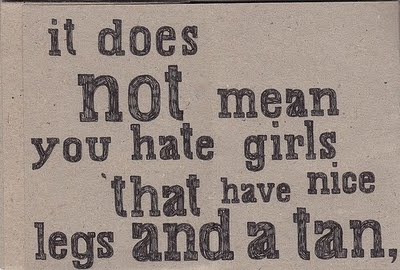
I discovered Maren, or frl.zucker, when I was looking for a banner for this blog. Freshly inspired by a friend, who in a moment of crisis told me to do as Kathleen Hannah does, I looked for something that embodies the fierce spirit of the riot grrl brand of militant, but positive feminism. I wanted something that would also motivate the shit out of me. And I found frl.zucker's drawings! I can't remember what phrase I googled, and I don't want to guess, but I can assure you it was somewhere between embarrassing and awesome. frl.zucker is totally not afraid to be embarrassing though. Her blog is very personal, it sometimes reads like a story. And though she never spells it out, you get a feeling she, too, is looking for motivation and inspiration, trying to overcome something that's preventing her from feeling 100% every day. I can really relate to that, and probably so can very many girls and women. It's nice to find inspiration to act in one another. Maren told me that the banner illustration is of her and her best friend Hannah reassuring her she could do anything, which is really sweet, and also really important. If you have a best friend, it's definitely a thing you should tell her once in a while.


Apart from sharing her story and A LOT of awesome, awesome links + posting nice photos, frl.zucker uses a lot of text in her drawings. That's what interested me in her work a lot - exploring the intersections of images and words. It's a really common medium, if you think about it (comic strips, graphic novels, graffiti, prints, even traditional illustration to an extent, and most of graphic design), but one that I feel is left out from a lot of investigation. We think of type as a separate art form, and images as works on its own, or as ones as additions to others, but rarely as a whole. But as Maren put it, it 'lets [one] think about stuff in a more complex way', and it's impossible to choose which one describes the other - they are both equally important, integral elements of a whole.


frl.zucker recently contributed to a scrapbook released as part of Kate Nash's new album, and also designed some tour t-shirts for her. She also made a fabulous press kit for a band called Desperate Teenage Girls, whom I know nothing more about, as they apparently "refuse to put anything about themselves online..."

Maren kindly answered some questions just for Women, Fire and Dangerous Things, and in an awesome handwriting way. My questions are sometimes a bit vague, but it's a really interesting contribution - thank you!


If you wanted to ask frl.zucker anything else, she has a question form thingy of her own, and often replies to questions on her blog. She also has a Flickr, Etsy, and last.fm. And as I hope you can tell from this post, she's pretty awesome.